Zoho for MSMEs: The ₹25,000 Opportunity Is Bigger Than the Discount
For an MSME, technology is often treated as an expense.
CRM is an expense.
Accounting software is an expense.
HR software is an expense.
Automation is an expense.
Analytics is an expense.
AI is an expense.
But there is a bigger question businesses should be asking:
What is the cost of not having the right technology?
Lost leads.
Delayed follow-ups.
Duplicate data.
Manual reporting.
Inventory mistakes.
Delayed payments.
Poor customer visibility.
Employees spending hours on repetitive work.
Management making decisions without real-time information.
These costs rarely appear as a separate line item on the balance sheet.
But they can quietly limit growth.
This is why Zoho for MSME is more interesting than simply another software incentive.
For eligible Indian MSMEs, Zoho has created a program designed to reduce the initial cost of adopting its business applications. But the bigger opportunity is what a business can build during that adoption window.
A connected digital business.
India’s MSMEs are not operating in a technology vacuum.
Most businesses already use technology.
They may have:
The problem is that these systems frequently operate independently.
Sales has one version of the customer.
Finance has another.
Operations has another.
HR maintains another database.
Management receives spreadsheets.
The business technically has software.
But it does not necessarily have a technology architecture.
That distinction is becoming critical.
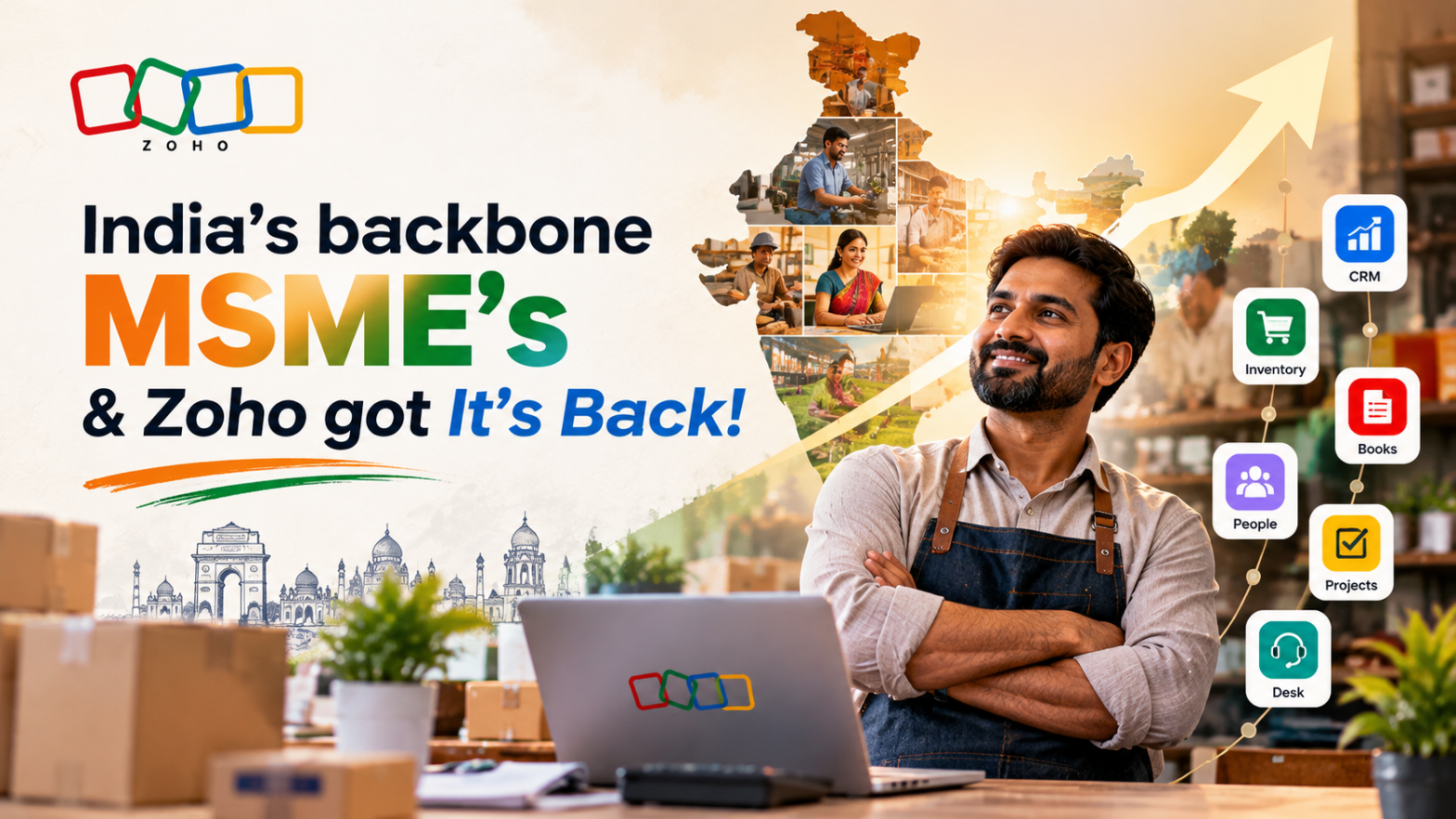
Zoho for MSME is a program aimed at eligible Indian MSMEs.
Businesses with an active Udyam registration can apply for the program.
Zoho states that eligible businesses can receive credits covering up to 50% of qualifying Zoho subscription costs, up to ₹25,000, with the credits valid for up to 360 days.
The program is therefore designed to lower the initial financial barrier for businesses looking to adopt Zoho applications.
But the real question is not:
“How much can an MSME save?”
It is:
“What can an MSME build with the technology it can now afford to adopt?”
That is a much more interesting question.
The headline number will naturally attract attention.
₹25,000 can make technology adoption easier.
But the real value lies in what happens after the subscription is activated.
An MSME could use this opportunity to rethink:
Instead of buying another isolated application, businesses can start building a connected technology ecosystem.
The credit is temporary.
The architecture can last for years.
That is why the technology decision matters more than the discount.
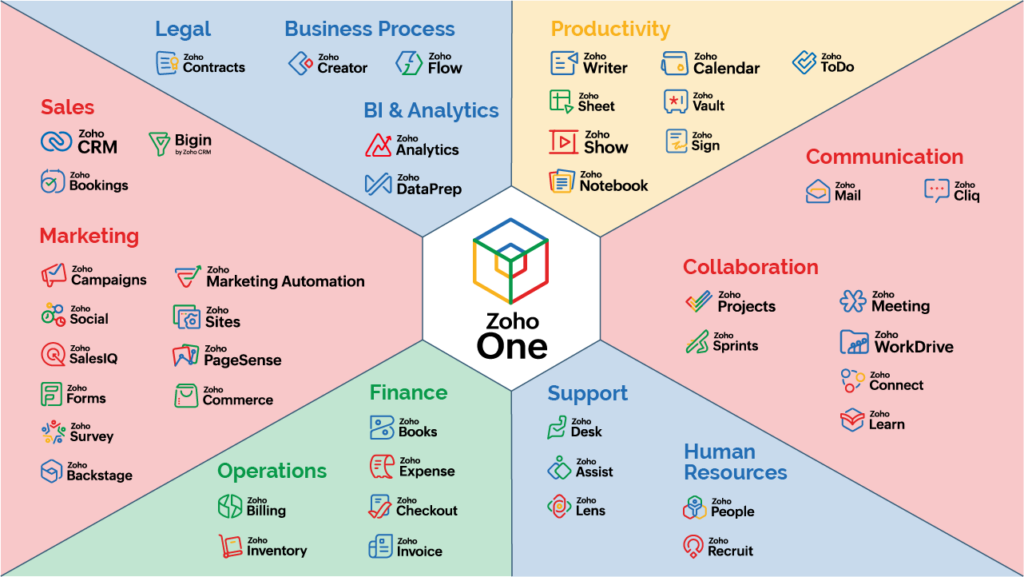
One of Zoho’s biggest strengths is the breadth of its application ecosystem.
A growing business can potentially build across areas such as:
Zoho CRM
Lead management, accounts, contacts, opportunities, pipelines, activities, automation, forecasting and customer lifecycle management.
Zoho Books
Accounting, invoicing, expenses, payments, tax-related processes and financial reporting.
Zoho Inventory
Stock management, orders, warehouses, fulfilment and inventory visibility.
Zoho Desk
Tickets, customer service, knowledge management, SLAs and support workflows.
Zoho Campaigns and Zoho Marketing Automation
Email campaigns, customer journeys, lead nurturing and marketing automation.
Zoho People
Employee records, leave, attendance, HR processes and workforce management.
Zoho Projects
Project planning, tasks, milestones, timesheets and delivery management.
Zoho Analytics
Business intelligence, dashboards, reporting and data analysis.
Applications such as Zoho Workplace provide communication, productivity and collaboration capabilities.
Zoho Flow, Deluge, APIs and webhooks can connect applications and automate business processes.
The important point is not that an MSME needs every application.
It doesn’t.
The point is that the business can build its stack around its actual operating model.
Consider a simple business lifecycle.
A lead arrives through the website.
↓
CRM captures the lead.
↓
Sales qualifies the prospect.
↓
The opportunity moves through the pipeline.
↓
A quotation is generated.
↓
The customer accepts.
↓
The transaction reaches finance.
↓
Inventory processes the order.
↓
The customer receives communication.
↓
Support can access the customer’s history.
↓
Management sees the entire process through analytics.
Now compare that with:
CRM → Spreadsheet → Email → Accounting Software → WhatsApp → Another Spreadsheet → Manual Report
Both businesses may have the same number of employees.
But their operational capacity can be very different.
The difference is data flow.
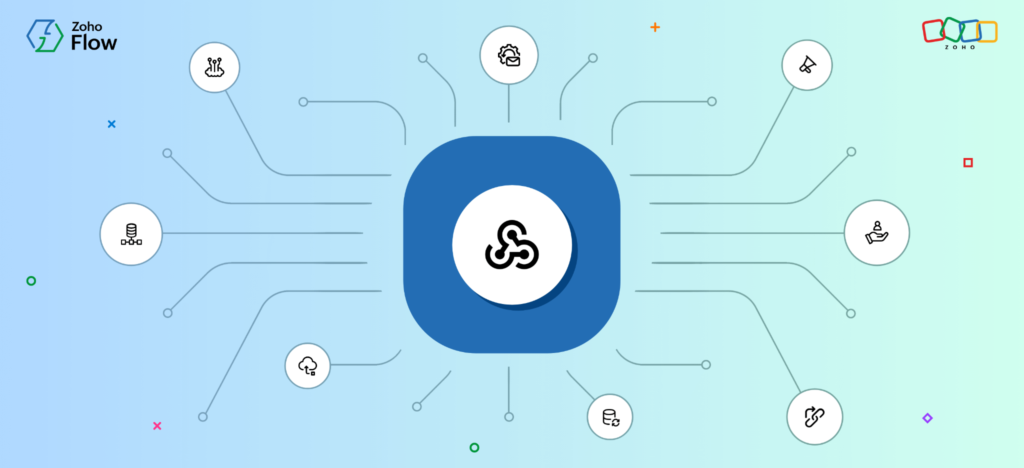
Buying applications is easy.
Making them work together is the difficult part.
This is where technologies such as:
become important.
For example, a CRM event can trigger an accounting workflow.
A payment status can update a customer record.
An inventory event can trigger customer communication.
A support ticket can retrieve CRM information.
An external application can send information into Zoho through an API.
This changes the role of software.
Applications stop behaving like isolated destinations.
They become components of a connected architecture.
MSMEs often have a hidden workforce problem.
Employees spend time doing work that does not require human judgment.
Copying information.
Sending reminders.
Updating records.
Preparing reports.
Assigning leads.
Creating notifications.
Following up on routine events.
Checking statuses.
Moving information between systems.
Automation can remove a significant amount of this repetitive work.
For example:
New lead → CRM record → Lead assignment → Notification → Follow-up task
Or:
Deal won → Customer creation → Order process → Finance workflow → Customer communication
Or:
Payment overdue → System identifies account → Reminder → Task creation → Escalation
The goal is not automation for its own sake.
The goal is to allow people to spend more time on work that actually requires people.

Many MSMEs know their revenue.
Far fewer have a complete view of why revenue is changing.
Analytics can connect information across business functions.
Management can begin asking:
The shift is from:
“What happened?”
to:
“Why did it happen?”
and eventually:
“What should we do next?”
This is where the MSME technology conversation becomes even more important.
AI is not a magic layer that can simply be placed on top of disconnected software.
AI needs context.
If customer data is scattered across spreadsheets, email, CRM and accounting systems, an AI assistant has limited business context.
But if the organization’s data is structured and connected, AI can become significantly more useful.
The progression looks like:
Digital Data
↓
Connected Systems
↓
Automation
↓
Analytics
↓
AI-Assisted Operations
This is why digital infrastructure matters before AI adoption.
An MSME that builds good data architecture today is also preparing itself for more advanced AI capabilities tomorrow.
This is a common mistake.
A company adopts an AI chatbot.
Then another AI tool for marketing.
Another AI tool for writing.
Another AI tool for analytics.
Another AI tool for customer service.
The result?
More software fragmentation.
The better approach is to ask:
Where should intelligence exist inside the business process?
AI could assist sales.
AI could help support teams.
AI could assist employees.
AI could analyze business data.
AI could help identify anomalies.
AI could summarize customer interactions.
AI could support decision-making.
The objective should be AI inside the workflow, not AI as another standalone application.
As businesses connect more systems, another issue becomes critical:
Security.
More applications mean more data.
More integrations mean more data movement.
More automation means more system-to-system actions.
More AI means potentially more interaction with business information.
Therefore, MSMEs need to think about:
Digital transformation without security architecture simply creates a larger digital attack surface.
An MSME may have 10 employees today.
It may have 50 tomorrow.
Then 200.
If the technology architecture was designed correctly, the business does not necessarily need to rebuild its entire operating model each time it grows.
The same systems can expand.
More users.
More records.
More workflows.
More integrations.
More automation.
More analytics.
This is where scalability becomes more important than simply choosing the cheapest software.
Cheap technology can become expensive when the business outgrows it.
For businesses that require broader coverage, Zoho One changes the conversation further.
Instead of asking:
“Which software do I need?”
the organization can ask:
“Which parts of our business should exist inside one connected ecosystem?”
That could include:
CRM + Books + Inventory + Desk + People + Projects + Analytics + Flow
The exact combination depends on the business.
A manufacturing company may prioritize inventory and operations.
A professional-services company may prioritize CRM, Projects, Books and People.
An e-commerce business may prioritize CRM, Inventory, Books, Analytics and customer support.
A growing startup may begin with CRM and Books and expand later.
The architecture should follow the business.
This point is important.
Buying Zoho does not automatically transform an organization.
A badly designed CRM is still a badly designed CRM.
An unnecessary workflow can create more complexity.
Poor data can contaminate every connected application.
Excessive customization can create maintenance problems.
An integration built without proper error handling can create data inconsistencies.
Therefore, the real value comes from implementation strategy.
A strong MSME implementation should begin with questions such as:
Website?
Referral?
Social media?
Marketplace?
Phone?
Walk-in?
Who qualifies it?
Who owns it?
What determines the next stage?
Quotation?
Order?
Payment?
Delivery?
Invoice?
Support?
Renewal?
Upsell?
Feedback?
Retention?
Revenue?
Pipeline?
Cash flow?
Inventory?
Customer retention?
Employee performance?
Once these questions are answered, the technology architecture becomes much clearer.
There is a tendency to measure technology by how much money it saves.
That is only one metric.
The bigger opportunity may be capacity creation.
If automation saves 20 hours every month, the business has not merely saved employee time.
It has created 20 hours that can be redirected toward:
Technology therefore becomes a capacity multiplier.
And for an MSME, capacity can directly influence growth.
The program can be viewed in three layers.
Reduce the financial barrier to adopting business software.
Move business processes away from disconnected manual systems.
Connect data, automate processes, introduce analytics and prepare the business for AI.
The first layer gets attention.
The third layer creates long-term value.
India does not need every MSME to become a technology company.
But every MSME increasingly needs to become technology-enabled.
Competition is becoming faster.
Customers expect immediate responses.
Employees expect digital workflows.
Management expects real-time information.
AI is changing productivity.
Cybersecurity threats are increasing.
And businesses cannot continue scaling through spreadsheets and manual coordination indefinitely.
The next generation of MSMEs will need technology that is not simply installed.
It needs to be architected.
The more important question is:
“Can we afford to keep running the business without a connected digital system?”
Because the cost of fragmentation can become much larger than the cost of software.
Every missed lead.
Every duplicated record.
Every manual report.
Every delayed invoice.
Every inventory mistake.
Every hour spent copying information.
Every customer interaction without context.
Every decision made without reliable data.
Together, they create a technology tax on growth.
Zoho for MSME can reduce the barrier to entering the digital ecosystem.
But the real opportunity is much larger.
It is about helping an MSME move through the technology maturity curve:
Manual → Digital → Connected → Automated → Data-driven → AI-enabled
That is the journey that matters.
The ₹25,000 credit may help an MSME start the journey.
What the business builds with that opportunity is what determines where it ends up.
UniCloud IT Services helps MSMEs and growing organizations design, implement and integrate Zoho ecosystems across CRM, finance, inventory, HR, customer support, analytics, automation and AI-enabled workflows.
Our approach focuses on business process architecture, data architecture, application integration, automation, security and scalable implementation—helping businesses move beyond software adoption toward a connected digital operating model.