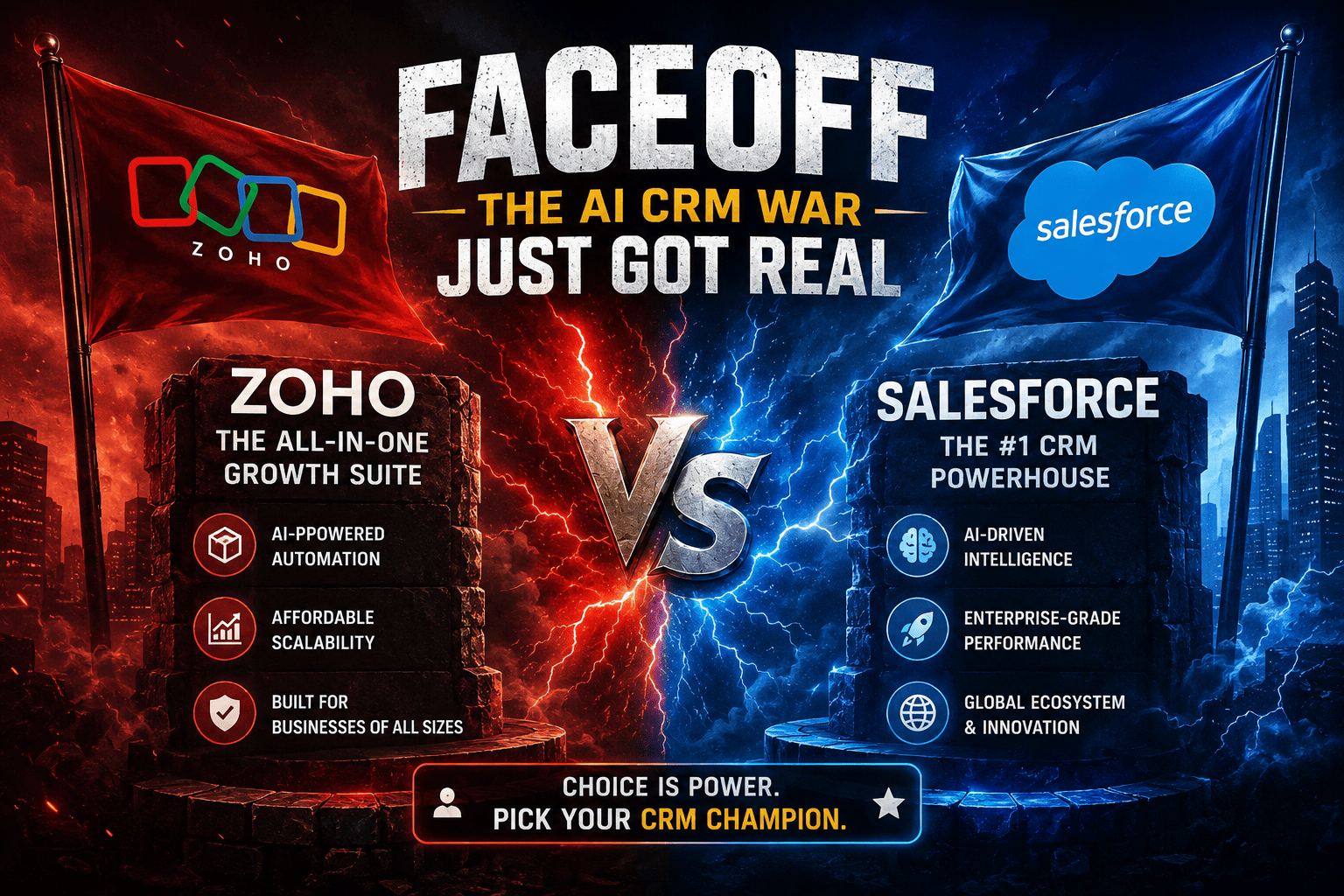
For years, the CRM market followed a familiar hierarchy. Salesforce led the enterprise world, while Zoho became a strong choice for small and mid-sized businesses.
However, Zoho AI CRM is changing that conversation in 2026. Zoho is moving beyond simple AI assistants and building AI deeper into CRM operations, workflows, automation, and cross-app processes.
As a result, the competition is no longer only about which CRM has more AI features. Instead, the bigger question is which platform can use AI to improve how businesses actually operate.
Quietly and strategically, Zoho has started building something surprisingly serious: an AI-first operational CRM ecosystem.
For the first time in a long time, Salesforce may have a legitimate reason to pay attention.
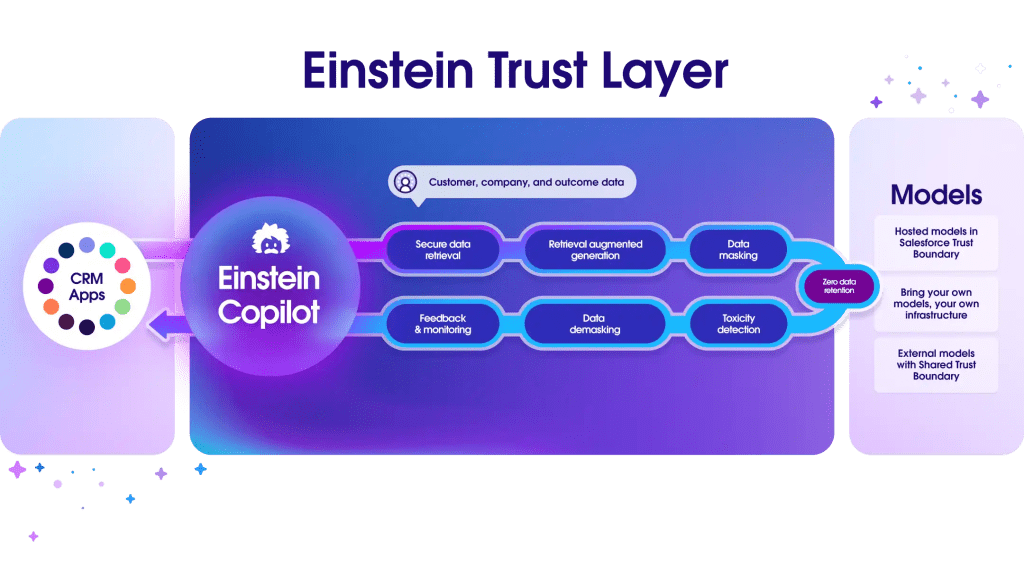
This distinction is important.
Most CRM AI today still feels like an assistant layer added on top of existing software. For example, AI may help users:
These capabilities are useful. However, they don’t fundamentally change how the CRM operates.
Zoho’s recent direction feels different. Instead of treating AI only as a productivity add-on, the company is embedding intelligence deeper into operational workflows.
That includes:
Therefore, this approach is much closer to operational AI infrastructure than simple assistant tooling.
And that changes the competitive conversation entirely.
Salesforce dominates enterprise AI headlines largely because of its scale and visibility.
However, many companies still struggle with:
For many mid-market organizations, enterprise AI can become another technology layer that needs to be configured and managed.
Zoho, meanwhile, appears to be pursuing something more practical: AI as operational acceleration.
In other words, the focus is not simply on presenting AI to the user. Instead, the goal is to use AI within everyday business operations.
That distinction could matter significantly over the long term.
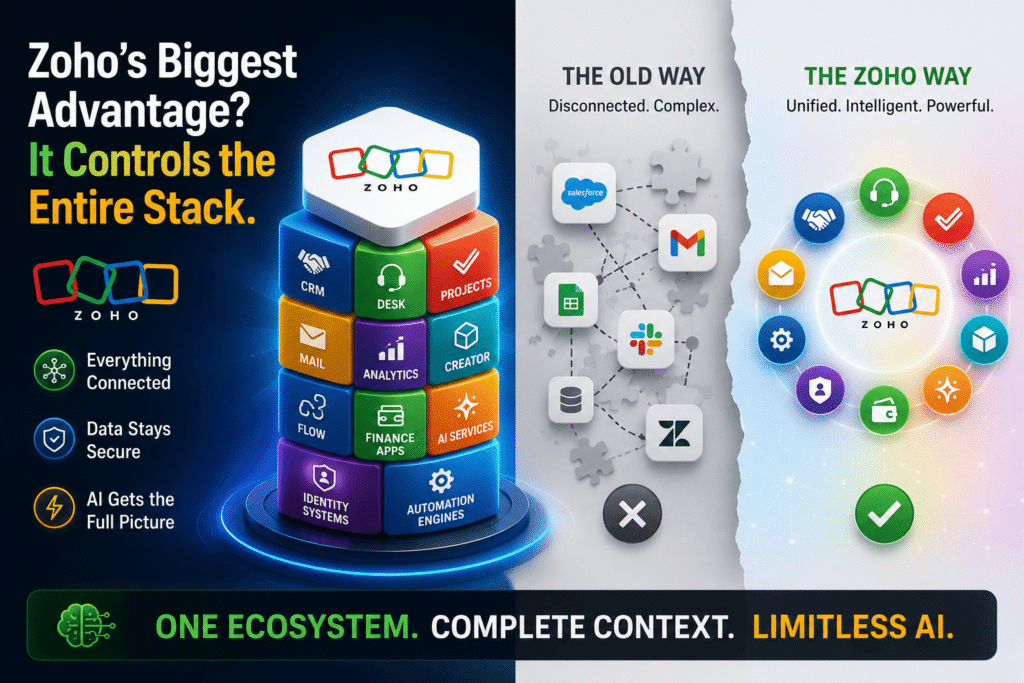
This is where the market may be underestimating Zoho.
Unlike SaaS vendors that rely heavily on disconnected third-party products, Zoho has a broad ecosystem of business applications and technology services.
The ecosystem includes:
Consequently, Zoho can connect AI with a broad amount of operational context.
For example, AI becomes more useful when it can work with:
Many companies still have this information spread across multiple platforms.
By comparison, businesses using a broader Zoho ecosystem may already have much of that context available across connected applications.
Therefore, this could become an important architectural advantage for Zoho AI CRM.
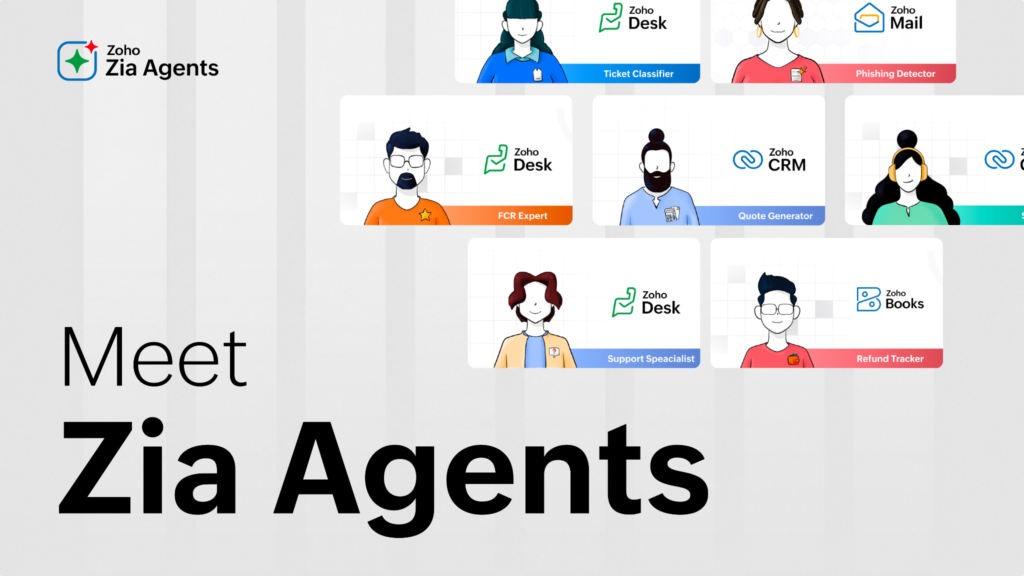
Zia Agents may be one of the strongest signals of where Zoho’s AI strategy is heading.
This isn’t simply about chatbot automation. Instead, it points toward more autonomous operational systems.
Traditional CRM automation generally follows predefined logic:
If X happens → trigger Y action.
Agentic systems introduce a different approach.
Depending on their configuration and capabilities, AI agents can help with tasks such as:
As a result, businesses can begin moving beyond rigid automation toward more context-aware operations.
Meanwhile, much of the broader CRM market is still heavily focused on AI copilots and assistant experiences.
This may be one of the most interesting parts of Zoho’s strategy.
While much of the AI industry focuses on flashy demonstrations and conversational interfaces, Zoho’s direction increasingly emphasizes operational efficiency.
Businesses generally need improvements such as:
Of course, conversational AI can still be useful. However, its value becomes much greater when it connects directly with real business processes.
Therefore, Zoho’s AI direction aligns closely with practical operational challenges.
Historically, many growing businesses viewed CRM adoption as a progression.
A company might begin with a simpler platform and later move toward a more complex enterprise CRM as its requirements increased.
However, AI could disrupt that assumption.
In the AI era, the winning CRM may not necessarily be:
Instead, it may be the platform that:
As a result, the competitive environment could look very different from the traditional CRM market.
The real threat isn’t necessarily that Zoho suddenly overtakes Salesforce in enterprise market share.
Instead, the competitive pressure could be more subtle.
Zoho could increasingly become:
That combination can become particularly relevant during periods when organizations are closely evaluating technology costs and operational efficiency.
For example, companies increasingly care about:
Therefore, brand recognition alone may not determine which CRM businesses choose.
A balanced comparison also needs to acknowledge Zoho’s challenges.
Depending on the organization’s requirements, considerations can include:
Meanwhile, Salesforce remains particularly strong in areas such as:
Therefore, this competition is far from settled.
Nevertheless, Zoho’s AI development makes the comparison increasingly interesting.
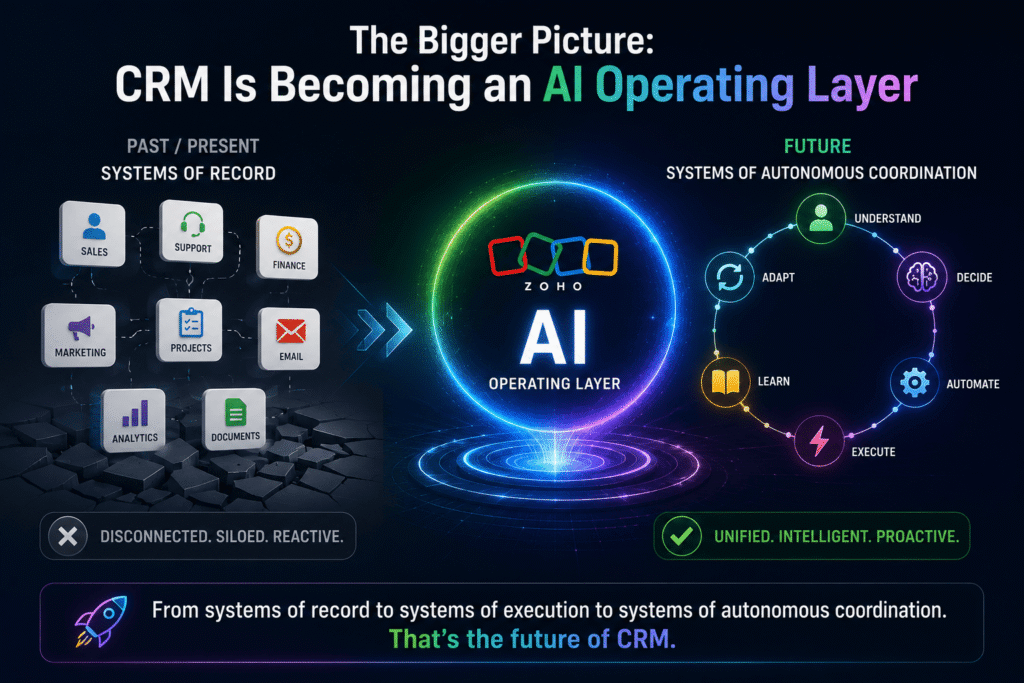
The larger story extends beyond Zoho versus Salesforce.
CRM systems themselves are evolving.
Traditionally, CRM platforms were primarily systems of record.
Increasingly, however, they are becoming systems of execution.
Eventually, AI could push them further toward systems of intelligent coordination.
This transition could affect:
Consequently, the CRM of the future may look significantly different from today’s dashboard-heavy CRM experience.
Zoho’s current AI direction appears closely aligned with that broader shift.
For businesses, the most important question is not whether Zoho or Salesforce wins an AI feature race.
Instead, organizations need to evaluate how AI affects their actual processes.
For example, businesses should consider whether their CRM can connect customer data, workflows, support processes, finance information and automation without creating unnecessary complexity.
Additionally, companies should evaluate how much human oversight their AI workflows require and which decisions should remain deterministic.
Ultimately, the strongest AI strategy will depend on both technology and implementation quality.
For years, Zoho was often viewed primarily as an affordable CRM alternative.
However, in 2026, that conversation is becoming more nuanced.
Zoho is no longer competing only on price. Instead, its AI strategy increasingly focuses on operational intelligence, connected applications and context-aware automation.
Meanwhile, Salesforce continues to bring substantial enterprise scale, ecosystem depth and established market presence.
Therefore, the future competition between the two platforms may not simply come down to who has more AI features.
It may depend on which platform can turn AI into measurable improvements across real business operations.
If Zoho continues developing its AI ecosystem in this direction, Zoho AI CRM could become an increasingly serious part of the Salesforce competitive conversation.